There has been much talk recently about economic inequality, often specifically
between white people and black people within the United States. Emotions usually run
high in these discussions, especially among those who see this inequality as evidence of
racism within the United States. For example, the Economic Policy Institute published an
article on January 11 titled “Racial inequalities in wages, income, and wealth show that
MLK’s work remains unfinished” which argued that “measures of racial economic
inequality show that we are a long way from remedying the vestiges of racism and the
centuries of federal, state, and local policies that created these disparities.”(1) This view
shows a rather myopic view of economics and also has rather dangerous implications.
For economic inequality is not in and of itself an evil; whereas economic equality is not
only morally reprehensible, but is also incredibly injudicious.
Before I explain the non harms of economic inequality, I should present my arguments
for why the opposing view is so dangerous. My reasoning is simple; the only way to get rid of
economic inequality is to violently violate the rights of many people worldwide. The question
may be raised that who said that economic inequality needs to be abolished? The answer is that
anyone who argues that any form of economic inequality “remains a huge issue that our nation
must come to terms with and resolve” is arguing that economic inequality is intrinsically wrong.(1)
What must be done in order to rectify this “evil?” The only way to totally rectify this is to
legislate a world wide “Robin Hood” system of taking from those who have “too much” and give
it to those who “have too little.” Though perhaps the quote “[f]rom each according to his ability,
to each according to his need” better sums up this idea.(2)
The question then becomes why I so vehemently oppose this idea. The answer to this
question is primarily that this system will never truly come into fruition. When one uses the
USSR or Venezuela as examples of why communism doesn’t work, one of the first responses is
that those examples are not “real” communism/socialism so as to invalidate them. However,
what this position fails to understand is that “real” communism/socialism cannot be realized. Dr.
Jordan B. Peterson, a clinical psychologist and professor at the University of Toronto, explains
this issue incredibly well.(3)
economic inequality is to violently violate the rights of many people worldwide. The question
may be raised that who said that economic inequality needs to be abolished? The answer is that
anyone who argues that any form of economic inequality “remains a huge issue that our nation
must come to terms with and resolve” is arguing that economic inequality is intrinsically wrong.(1)
What must be done in order to rectify this “evil?” The only way to totally rectify this is to
legislate a world wide “Robin Hood” system of taking from those who have “too much” and give
it to those who “have too little.” Though perhaps the quote “[f]rom each according to his ability,
to each according to his need” better sums up this idea.(2)
The question then becomes why I so vehemently oppose this idea. The answer to this
question is primarily that this system will never truly come into fruition. When one uses the
USSR or Venezuela as examples of why communism doesn’t work, one of the first responses is
that those examples are not “real” communism/socialism so as to invalidate them. However,
what this position fails to understand is that “real” communism/socialism cannot be realized. Dr.
Jordan B. Peterson, a clinical psychologist and professor at the University of Toronto, explains
this issue incredibly well.(3)
“Let’s just say for a minute that some saint did get a hold of the tools of power and did try to
implement ‘from each according to his ability, to each according to his need’ and actually did
that in a pure and saint like manner. Here’s what would happen. The next people in the
revolutionary string, like Stalin, would come along and stab them in their bed in the middle of the
night and that would be the end of that.”(3)
Another reason I disagree with this system is that any change that introduces any system
that is not 100% “true” communism or socialism would result in a vast multitude of deaths, as
the USSR, Venezuela and many other countries’ attempts have clearly shown, along with the
clear violations of many human rights, such as violations of Articles 9, 10, 12, 17, 18, and 19 of
the United Nations’ Universal Declaration of Human Rights.(4)
implement ‘from each according to his ability, to each according to his need’ and actually did
that in a pure and saint like manner. Here’s what would happen. The next people in the
revolutionary string, like Stalin, would come along and stab them in their bed in the middle of the
night and that would be the end of that.”(3)
Another reason I disagree with this system is that any change that introduces any system
that is not 100% “true” communism or socialism would result in a vast multitude of deaths, as
the USSR, Venezuela and many other countries’ attempts have clearly shown, along with the
clear violations of many human rights, such as violations of Articles 9, 10, 12, 17, 18, and 19 of
the United Nations’ Universal Declaration of Human Rights.(4)
The argument could then be raised that one needn't treat global equality as a primary goal,
but that one should treat national equality as a foremost objective instead. This argument belies
an oftentimes ignorant and/or arrogant view about what a person “deserves.” This stems from
an inward focus, or thinking primarily about the self, which is at the base of the vast majority of
people’s mindset; it is the rare outlier that is perpetually outward thinking, or others focused.
This is especially true when the topic of wages is discussed. The economist Ludwig Von Mises
describes this mindset well: “If the American...says equality, he means expropriating the holders
of shares and bonds for his own benefit. He does not consider sharing with the unskilled workers
who earn less. At best, he thinks of equality of all American citizens. It never occurs to him that
the peoples of Latin America, Asia, and Africa may interpret the postulate of equality as world
equality and not as national equality.”(5)
but that one should treat national equality as a foremost objective instead. This argument belies
an oftentimes ignorant and/or arrogant view about what a person “deserves.” This stems from
an inward focus, or thinking primarily about the self, which is at the base of the vast majority of
people’s mindset; it is the rare outlier that is perpetually outward thinking, or others focused.
This is especially true when the topic of wages is discussed. The economist Ludwig Von Mises
describes this mindset well: “If the American...says equality, he means expropriating the holders
of shares and bonds for his own benefit. He does not consider sharing with the unskilled workers
who earn less. At best, he thinks of equality of all American citizens. It never occurs to him that
the peoples of Latin America, Asia, and Africa may interpret the postulate of equality as world
equality and not as national equality.”(5)
One may respond by claiming that those of one nation are the only people entitled to the
benefits of said nation’s production. However, the issue with this line of thinking is that once one
starts redistributing benefits from those who put effort and/or investments into the production of
a good/service, the same argument can be used to increase the amount of people who receive
said benefits. Even if one starts at dividing the profits from a company between the people of the
town the company is located in, the same argument could be made to expand the profits to each
person in the county, because people in the county and not just in the town support the
company. Then, the same argument could be made to expand the profits to the people of the
entire state, then the country, then the continent and then, finally, the entire world. Another way
to describe why this argument fails is because “[a]n American worker has no better title to claim
the savings of the American capitalist than has any foreigner.”(5)
benefits of said nation’s production. However, the issue with this line of thinking is that once one
starts redistributing benefits from those who put effort and/or investments into the production of
a good/service, the same argument can be used to increase the amount of people who receive
said benefits. Even if one starts at dividing the profits from a company between the people of the
town the company is located in, the same argument could be made to expand the profits to each
person in the county, because people in the county and not just in the town support the
company. Then, the same argument could be made to expand the profits to the people of the
entire state, then the country, then the continent and then, finally, the entire world. Another way
to describe why this argument fails is because “[a]n American worker has no better title to claim
the savings of the American capitalist than has any foreigner.”(5)
The argument could also be made that this action of redistributing profits would stifle
innovation and/or the creation of added production. This is because one of the main reasons for
a person to risk their financial capital for the production of a new, or additional, good/service is
because of the added profits they would reap if the good/service is produced. One could also
argue that beyond the idea of profits is the idea of a person gaining access to additional
goods/services if they increase their output of said good/service. Within a system that does not
allow an individual to increase their profits in such drastic fashion, the largest reason to innovate
and increase production would be removed, causing innovation to slow, if not cease. To quote
Milton Friedman, “[g]overnment can never duplicate the variety and diversity of individual
action...government would replace progress by stagnation, it would substitute uniform
mediocrity for the variety essential for that experimentation which can bring tomorrow's laggards
above today's mean.”(6)
So, if true economic equality is unachievable, what then should be done about the economic
differences between races? Is it true that this inequality comes from “the vestiges of racism and
the centuries of federal, state, and local policies?”(1) While many use this statistic as evidence of
structural racism, including those whose job titles include accolades such as “director of the
Economic Policy Institute’s Program on Race, Ethnicity, and the Economy,” the evidence seems
to suggest that other forces may be in play.(7) Political commentator Ben Shapiro introduces this
possibility quite well.(8)
innovation and/or the creation of added production. This is because one of the main reasons for
a person to risk their financial capital for the production of a new, or additional, good/service is
because of the added profits they would reap if the good/service is produced. One could also
argue that beyond the idea of profits is the idea of a person gaining access to additional
goods/services if they increase their output of said good/service. Within a system that does not
allow an individual to increase their profits in such drastic fashion, the largest reason to innovate
and increase production would be removed, causing innovation to slow, if not cease. To quote
Milton Friedman, “[g]overnment can never duplicate the variety and diversity of individual
action...government would replace progress by stagnation, it would substitute uniform
mediocrity for the variety essential for that experimentation which can bring tomorrow's laggards
above today's mean.”(6)
So, if true economic equality is unachievable, what then should be done about the economic
differences between races? Is it true that this inequality comes from “the vestiges of racism and
the centuries of federal, state, and local policies?”(1) While many use this statistic as evidence of
structural racism, including those whose job titles include accolades such as “director of the
Economic Policy Institute’s Program on Race, Ethnicity, and the Economy,” the evidence seems
to suggest that other forces may be in play.(7) Political commentator Ben Shapiro introduces this
possibility quite well.(8)
With rhetorical questions out of the way, one can look at actual data and attempt to draw
conclusions about the reality of this situation.Perhaps the best way to look at this situation is actually to look at similarities between those
in poverty and those in the middle class and see if any correlations can be drawn from the data.
Thankfully, that research has already been done. According to an article published in 2013 by
Ron Haskins, a senior fellow of economic studies at the Brookings Institute, “in a free society,
[you] enter adulthood with three major responsibilities: at least finish high school, get a full-time
job and wait until age 21 to get married and have children. Our research shows that of
American adults who followed these three simple rules, only about 2 percent are in poverty and
nearly 75 percent have joined the middle class (defined as earning around $55,000 or more per
year).”(9) After a review of these three categories-education, job status, and household type-it
would appear that they greatly affect how this situation should be viewed.
The first factor for wealth discrepancies is educational attainment. According to a report
published by the Bureau of Labor Statistics, the percentages of Whites and Blacks who held at
least a high school diploma in 2016 were nearly identical, 92 and 93 percent respectively.(10)
While this might look like evidence against the position I hold, the situation looks different when
one looks at college graduation rates. This is because, per the Pew Research Center, “Millennial
college graduates ages 25 to 32 who are working full time earn more annually—about $17,500
more—than employed young adults holding only a high school diploma.”(11) This affects the
situation discussed because not only was there a difference of 10 percentage points in
bachelor’s degree attainment between Whites and Blacks in 2016, but also this gap may slowly
be shrinking.(10) According to a 2015 report from the United States Census Bureau “[t]he gap
between Whites and Blacks remained stable, between 11 and 14 percentage points from 1988
to 2015.”(12) However, until newer reports are published, one cannot know for sure. This being
said, there is a clear discrepancy between the races when it comes to educational attainment
and since education has a very significant correlation with higher wages, one would have to
include a systemic reason for this discrepancy if one is to argue it does not help answer some of
the question of racial economic inequality.
The second factor mentioned was job status. The information given by the Bureau of Labor
Statistics on the demographics of full-time workers is rather complicated, though one can still
draw interesting conclusions from it. The Labor Force Statistics from the Current Population
Survey of 2017 by the Bureau of Labor Statistics forces one to do some calculations of their own
to find information on the racial demographics of full-time workers. It published that out of all,
124,525,000 full-time workers, the number of White men over 20 was 56,620,000 and the
equivalent statistics for White women, African American men and African American women were
40,696,000; 7,452,000; and 7,803,000 respectively.(13) This means that White people made up a
slightly disproportionate amount of full-time workers, at approximately 78%, while African
Americans made up a more proportionate amount at approximately 12%.
Again, this small difference seems to do the opposite of bolstering my thesis when seen in a
vacuum. However, the larger difference that should be addressed is the issue of unemployment.
While the employment to population ratio for Whites and African Americans are close, 60.2%
and 56.4% respectively, the unemployment rate for African Americans is almost twice as high as
Whites at 8.4% to 4.3%.(14)
With this information, some argue a form of systemic oppression is to blame for this disparity.
For example, many use a 2004 study conducted by Marianne Bertrand and Sendhil
Mullainathan to argue that “African Americans face a number of barriers to employment,
including biases from recruiters. The study found that employers were 50 percent more likely to
call in the person with the white-sounding name for an interview, even though the two résumés
had exactly the same qualifications.”(15) The logical progression is that if people with “white
sounding” names get 50% more callbacks, then people with “black sounding” names receive
that many fewer callbacks. This results in them being less likely to get jobs, let alone well paying
jobs. Therefore, this discrepancy in callbacks results in wealth inequality.
However, this study fails to provide evidence for the premises after “employers were 50
percent more likely to call in the person with the white-sounding name for an interview.”(15) In
fact, the study even said that “[o]ur procedure, however, simply measures callbacks for
interviews. To the extent that the search process has even moderate frictions, one would expect
that reduced interview rates would translate into reduced job offers. However, we are not able to
translate our results into gaps in hiring rates or gaps in earnings.”(16) Therefore, one cannot say
definitively about whether this callback discrepancy causes economic inequality or not.
The last factor mentioned was household type. Specifically, that one should only have
children within the context of marriage. This idea comes from the connecting word ‘and’ in the
statement “wait until age 21 to get married and have children.”(9) This may be the most important
factor in understanding this racial inequality as it shows the largest differences between the
races. First, there is the fact that married couples have a larger average income than other types
of households. From the US Census Bureau Publication Income and Poverty in the United
States: 2016, “For family households, married-couple households had the highest median
income in 2016 ($87,057), followed by households maintained by men with no wife present
($58,051). Family households maintained by women with no husband present had the lowest
median income ($41,027).”(17)
Also, there is the issue of the number of breadwinners in each family. According to Mark
Perry of the American Enterprise Institute, “one of the main factors in explaining differences in
income among US households is the number of earners per household...the unadjusted ratio of
average income for the highest to lowest quintile of 16.1 times...falls to a ratio of only 3.5 times
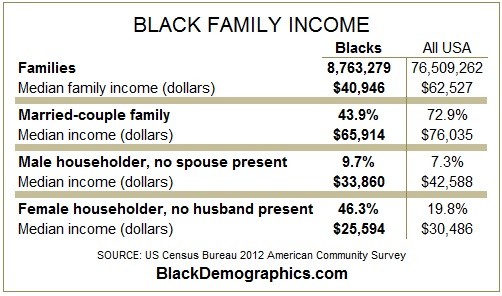
when comparing ‘income per earner’ of the two quintiles.”(18) How does this information relate to
the topic at hand? Per the US Census Bureau’s 2012 American Community Survey, the
percentage of single parent African American households, 56%, was over twice the national
average of 27.1%.(19)
To be clear, this information should not be used to argue that income inequality has nothing
to do with racism, that would be incredibly injudicious. For one would simply need to bring forth
a single instance of a single person whose income was punished solely because of the color of
their skin to break the foundations of that argument. One could also argue that the average
black family has had less generations that were able to garner wealth than the average white
family because of slavery and therefore the income disparity is partially due to racism. Rather,
what I have done here is put forth an argument that while race could be partially responsible for
the economic disparity between races, it is not the sole factor nor is it the largest factor.
According to the evidence previously cited, it would seem that a large part of the differences
between races come down to cultural differences and interpersonal decisions.
Finally, is this essay arguing that economic inequality is an inevitable or necessary evil? By
no means. Within a capitalistic market system, economic inequality is morally neutral as it is the
result of a myriad of voluntary exchanges of money for goods and/or services. As long as
contracts are kept and laws followed, the mere existence of economic inequality is neither moral
nor immoral. Instead, it is a byproduct of the existence of goods and/or services that a large
enough portion of the general population wish to purchase that they would pay a substantial
amount more than the costs of production to purchase said good/service. It is similar to the
mere existence of student loan debt. While outside the scope of this essay, there is evidence
that student debt usually is a consequence of an investment made that, for the vast majority of
people, results in higher wages which could not be made if it were not for the loans they took
out.(20)(21)
Through the essay, I have laid out my reasoning not only for the necessity of economic
inequality but also for its moral and racial neutrality. Given these arguments, it is my hope, not
simply that one would agree with what I have proposed, but rather that one would ponder these
propositions and discern whether they agree with what I have to say and the reasoning for their
decision. In doing so, one would not only better understand their position, and even worldview,
but also another’s position. This would, hopefully, result in a more nuanced discussion about
these topics as people are more likely to have constructive discussions on topics they better
understand.
Works Cited
- cos.gatech.edu/facultyres/Diversity_Studies/Bertrand_LakishaJamal.pdf